 Holiday Subscription Report 2026
 How to Win (and Keep) Holiday Subscribers in an Agentic World
A retention-first playbook grounded in BFCM benchmark data from The Groove Network, the largest enterprise subscription database.







Five things the data says about BFCM subscribers:

The median enterprise brand lifts enrollment 33% during BFCM, though roughly a third of that lift may come from existing customers.
Enrollment
Brands with the biggest BFCM enrollment spikes are 3x more likely to see a major spike in cancellations too.
The Paradox
BFCM cohorts drop off between the first and second order 5 percentage points more often than everyday cohorts.
The Pothole
BFCM subscribers who clear order 2 generate about 8% more revenue over 12 months than everyday subscribers.
The Payoff
A BFCM readiness checklist and a retention calculator that sizes the revenue at stake for your own cohort.
ReadinessRead on for what the data tells you to do at each of those moments, and what agents make possible with Autonomous Subscriptions for the first time this year.
BFCM 2026 is the first year agents can watch your subscriber base and act, while your team is running the rest of the busiest weekend of the year.
Until now, most brands would launch their holiday campaigns, monitor what they could, and find out weeks later whether the subscribers they acquired were worth the cost to get them. By the time the cancellation spike showed up in a report, the cohort had already drifted. By the time the payment failures stacked, the recovery window had closed.
That’s the model BFCM 2025 ran on. Gartner projects 40% of enterprise applications will include task-specific AI agents by 2026, up from less than 5% in 2025. This is the first BFCM where agents watching subscriber behavior in real time, flagging what’s moving, and acting before the window closes are an operational reality.
This report draws from The Groove Network, the largest enterprise subscription database, to show what actually happened to enterprise brands during BFCM 2025: where enrollment growth came from, where your BFCM subscribers drop off, and what a BFCM subscriber is actually worth once you carry them past the first 90 days.
At each of those moments, we show what the data tells you, what it doesn’t prove, and what Autonomous Subscriptions now make possible.
BFCM 2025, by the numbers
The Truth Behind Enrollment
The median enterprise brand sees a 33% lift in subscription enrollment during BFCM. Only 1 in 4 double it.
And brands aren’t just winning new customers. For the median brand, roughly a third of that lift comes from existing subscribers adding products or starting a second subscription.
A third of the enrollment growth you’ll celebrate on Monday isn’t from new customers at all. It’s existing subscribers adding a product or starting a second subscription. Growth hiding in plain sight.
This means the weekend is running in two directions at once. Your base is doing more for you than you’re giving it credit for, and it’s watching every new customer offer you run, with no way for you to see how those offers land. Protecting what you already have is half the growth story, and it’s the half that most aren’t focused on.
The BFCM Convergence
BFCM combines your highest acquisition costs with your lowest-margin first order.
The subscribers you win over the weekend are your most expensive customers of the year. They are acquired at peak competition, often on a discount that leaves almost nothing on the first order.
The point at which high costs to acquire converge with high discounts to convert.
A conceptual illustration of how acquisition cost and discount depth move across the year, not plotted from program data.
Effectively growing your base takes the basics done well: subscriptions visible wherever intent appears: on the PDP, cart, checkout, email, SMS and in-store and offers you've tested for what they're worth twelve months later, not just on the day.
In a recent Ordergroove analysis, curated incentives resulted in a 32% improvement in retention after the second order compared to flat rate discounts, proving that the way you structure incentives has a greater impact on retention than the shopper’s initial intent or purchase behavior.
Enrollment is the part everyone already optimizes. What happens around and after acquisition of those subscribers determines whether BFCM creates durable growth.
That leaves brands with two retention jobs: protect existing subscribers while the offer is live and carry the newly acquired cohort through its first major drop-off.
Around a third of BFCM enrollment lift may come from existing customers adding products or starting a second subscription, not new customers at all.
Win the signup. Give them a reason to stay.
See how signup experiences and incentives encourage repeat orders.
The Paradox
Your current subscribers are watching what you offer to win new ones.
The brands who had the biggest enrollment spikes (1.5x+ normal rate) are also 3x more likely to have a major spike in cancellations.
The brands that grew their base the most also put the most pressure on existing subscriber retention. Both pressures trace back to the acquisition offer itself.
What might explain this phenomenon:
The brands that tend to see the highest enrollment also usually offer the biggest incentives. Those new offers can sometimes create unintended responses among existing subscribers:
Perceived unfairness: A loyal subscriber who watches you offer a better deal to strangers feels devalued.
Arbitrage: Some existing customers cancel and re-subscribe to claim the new-customer price.
What you can do to prevent this:
Make your existing subscribers feel special with exclusive benefits, and give them a way to engage during BFCM that doesn't require touching their subscription.
Give existing subscribers add-on benefits.
Perks they can’t get anywhere else, on an order they’ve already placed.
Add any treats onto your next order and get 30% off—just because you’re already subscribed.
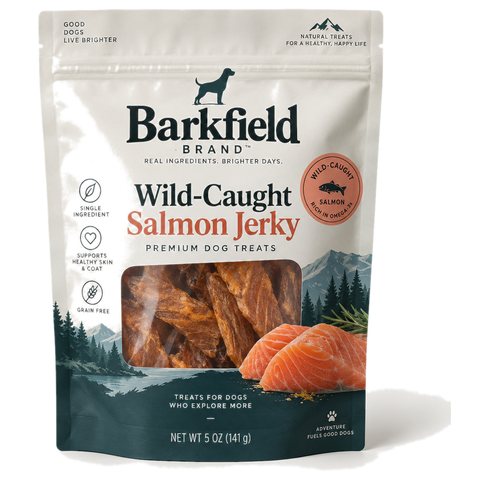
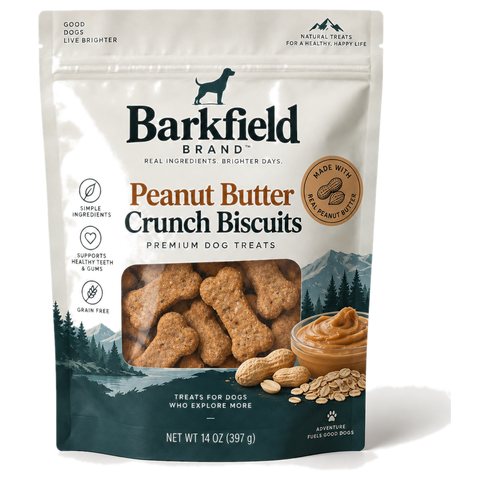
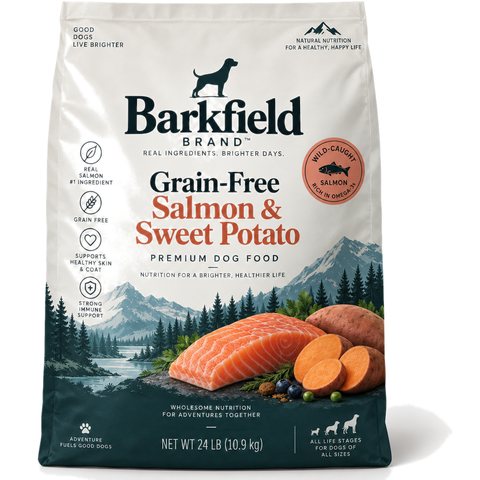
Make it easy to add discounts without canceling.
Let subscribers apply discount codes to their upcoming order, no new checkout or cancellation needed.
None of this means pulling back on acquisition. Two-thirds of BFCM growth comes from new subscribers, and for most brands the existing base holds up fine through the rush. They spend more and add more subscriptions, not fewer.
The risk isn’t the subscribers you already have. It’s the ones you just paid to acquire.
The brands that grow fastest during BFCM put existing subscribers at risk of feeling devalued or gaming the discount, so protect them as deliberately as you chase new growth.
Make staying more rewarding than starting over.
Give subscribers exclusive benefits and more control over their orders.
The Pothole
The second order is the hardest step in any subscription lifecycle.
The single biggest drop-off in the lifecycle happens between the first and second order for BFCM and everyday cohorts alike. BFCM cohorts clear it about 5 percentage points less often than the brand’s own everyday subscribers.
The Order 2 Drop-off
For the median brand, 33% of a BFCM-acquired cohort is lost between the first and second order, compared to 28% of an everyday cohort.
The second-order pothole lands at the worst possible point in the economics. A BFCM subscriber is the most expensive customer of your year. Lose them at order 2, and you’ve spent the acquisition cost without the recurring revenue to justify it.
The good news? The gap opens at order 2 and barely moves after. Months 4–12 add less than a point to it. If the gap kept widening, BFCM subscribers would just be lower-quality customers, which is a problem you can’t fix. Instead, the data points to a one-time hurdle you can overcome.
The whole gap opens by month 3.
Months 4–12 add less than a point to it.
Not every BFCM subscriber lost at order 2 is the same.
Two churned BFCM subscribers can look identical in the retention curve, both lost after the second order, for opposite reasons. One actively canceled. The other had a payment failure and lapsed without ever making that choice.
Of those who leave at order 2, about three-quarters actively cancel. Meanwhile, roughly 8% churn because of a payment failure.
Each requires a different strategy and approach.
Catch cancellations before they happen
Most of what you lose from BFCM gains is through cancellations. They may read as unavoidable, but there are opportunities to spot those patterns early, pre-empt them with the right retention play, and put the right save in front of those who still make it to the cancellation screen to bring a meaningful share back.
Spot cohorts at risk before they churn.
The agent flags the risk and drafts a tailored intervention. You review and approve.
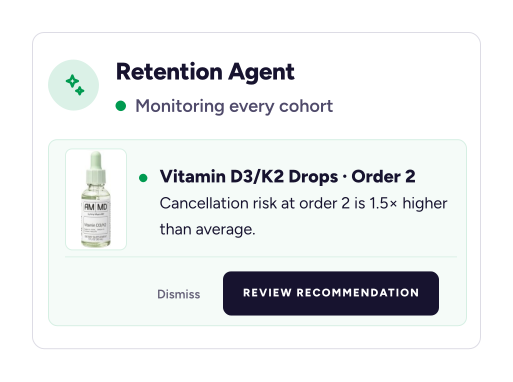
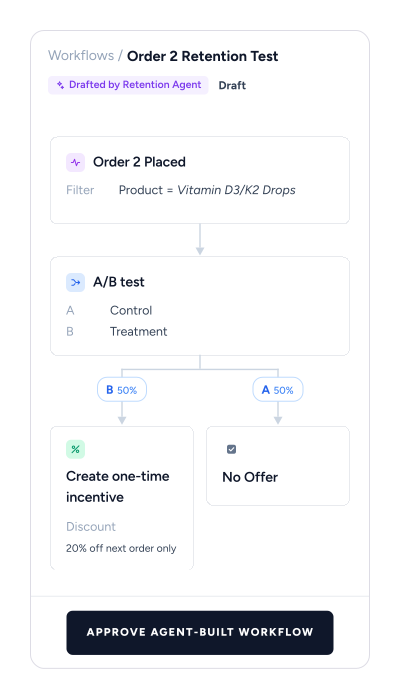
An agent-built retention test, ready for your approval.
Make staying feel rewarding.
With surprise & delight gifts, you can give subscribers another reason to look forward to their upcoming subscription order.
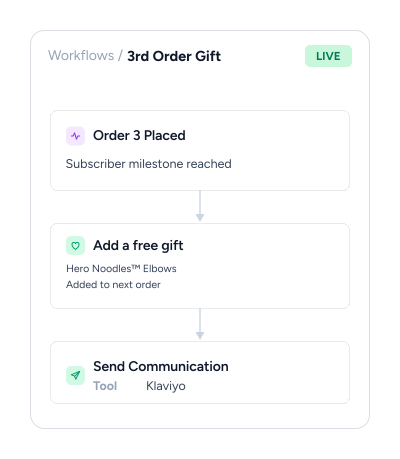

A milestone gift, automatically added to their subscription order.
Let their cancel reason shape your targeted save offer.
Match each cancellation reason with a save designed to address the subscriber’s real concern.
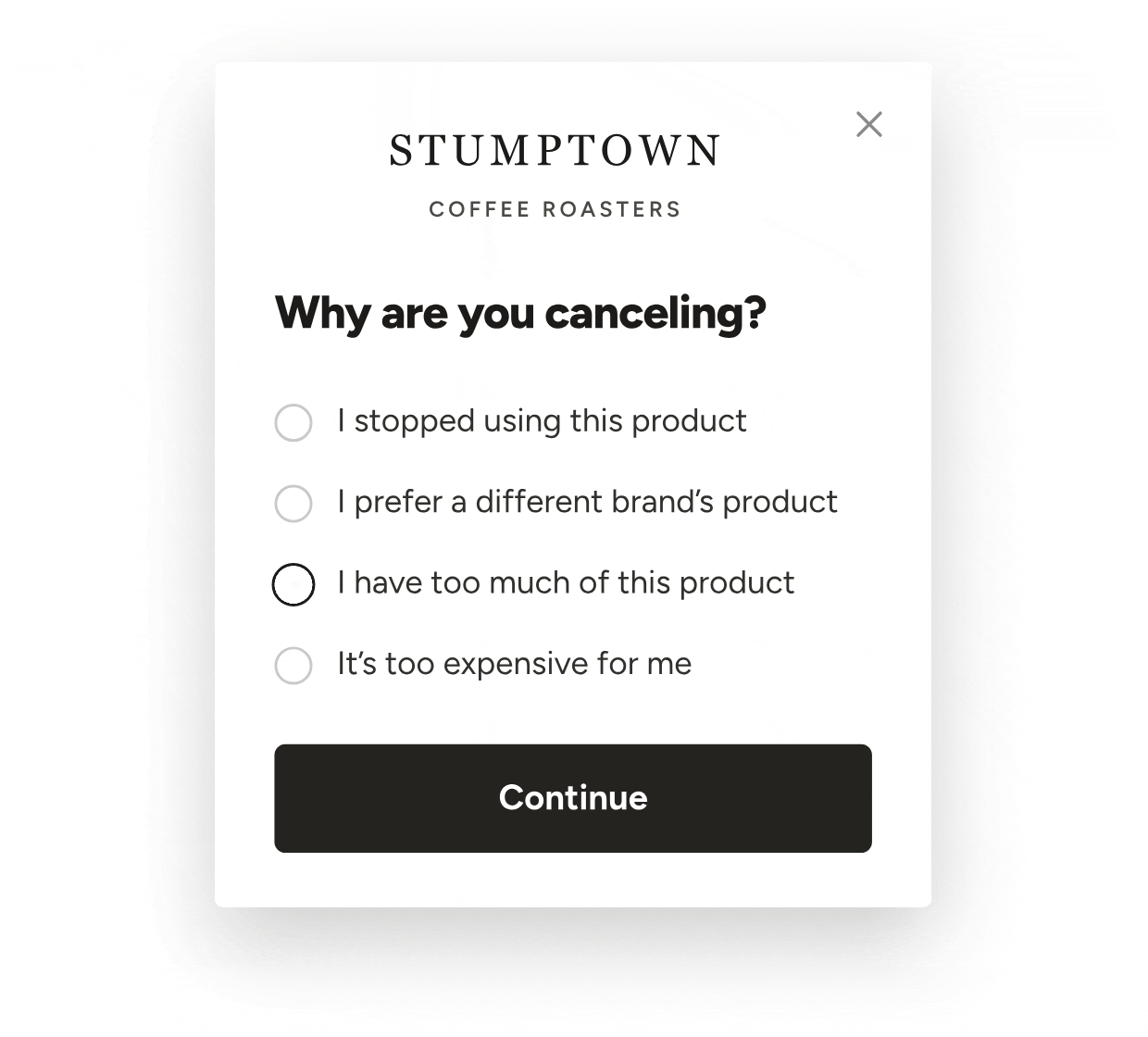
A skip addresses overstock while keeping the subscription active.
Give them a reason to come back.
Trigger winback communications and configure rewards when subscribers reactivate.
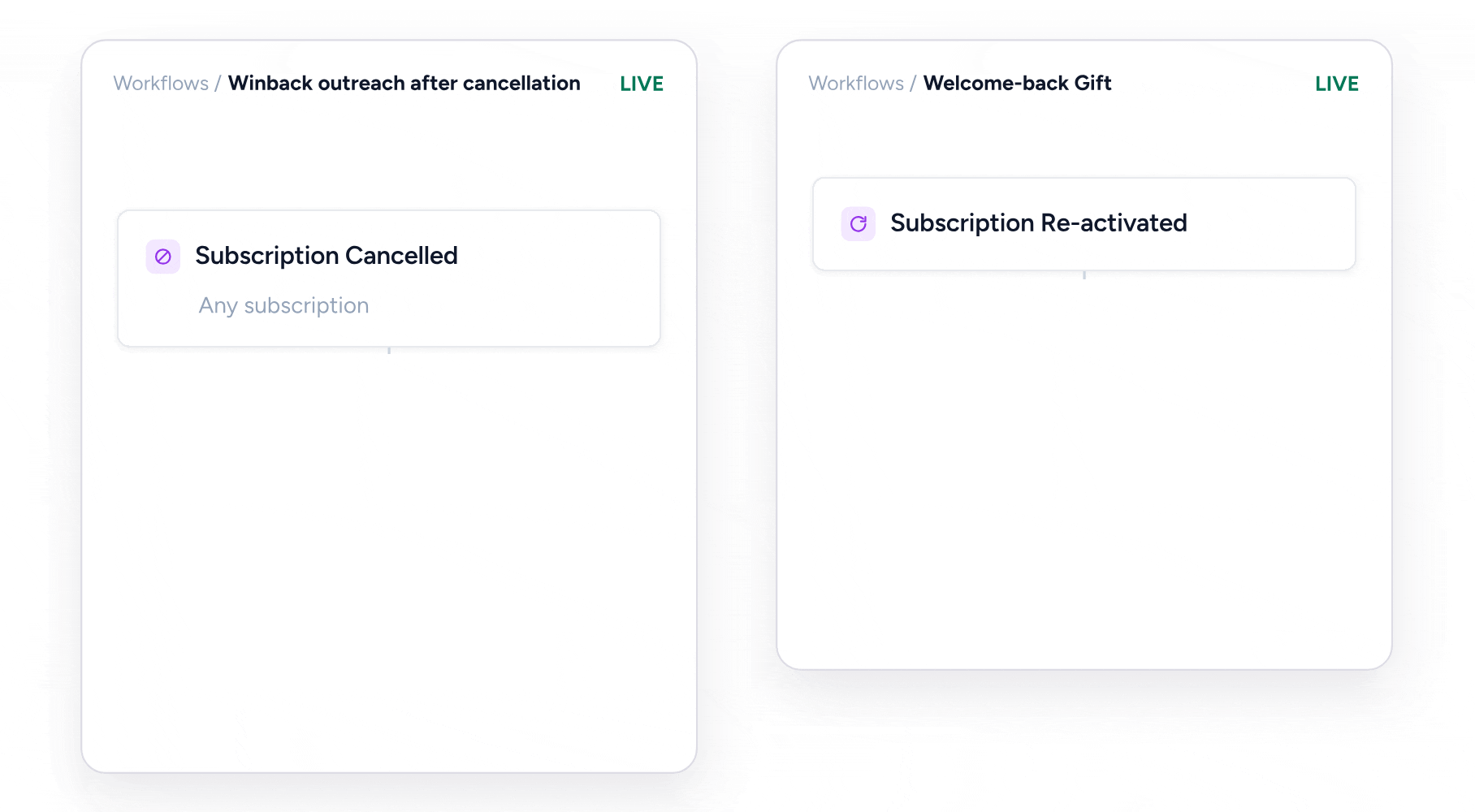
A gift on their next order encourages subscribers to return.
Automation and agents can both help you prevent cancellations, but they’re not the same.
A workflow is a rule you write before the weekend. It catches what you already knew to look for, but it can’t catch what you didn’t. Nobody is stopping to spot new risks during the holidays, or to build an intervention for them once they do.
An agent is always on, monitoring every cohort for risk of churn before it shows up in a report. It catches the patterns you never wrote a rule for and acts inside the window, while your team is too busy running the weekend to stare at a dashboard.
Automation encodes what you know in advance. Agents cover the ground nobody thought to check. Together, they keep more of what the weekend earned you.

“Ordergroove helped us launch a new retention strategy almost instantly, rewarding subscribers at key milestones without internal development. What could have taken a year or more to build in-house reduced subscription cancellations by 19% among milestone-eligible customers.”
among milestone-eligible customers
Fix failed payments before they become churn
A large segment of your BFCM churn leaves without intentionally deciding to. Roughly 8% of subscribers churn on a failed payment, and because none of them chose it, it’s the easiest share of your churn to win back.
Flag at-risk cards before the charge fails.
Proactively notify subscribers about at-risk payments with site-wide banners.
Make retries smarter, automatically.
Run experiments that recover more revenue with Payment Agent.
Cut the portal out of card updates.
Let subscribers update payments with no login or portal navigation required.
Retry automatically when the card updates.
Automatically retry eligible orders as soon as cards update.

 The Men’s Signature 6 Blade Razor
 The Humble Twin Handle
 Prep Scrub
 Beard Oil
 Payment failed
Hi Jane, we attempted to process your subscription order but there was an issue with the card on file.
Update your payment details to receive your next order.

Future subscriptions will use your new payment method, and any failed orders from the past 30 days will retry automatically.
View subscriptions in my account →The first BFCM where your retry strategy improves itself.
Most brands already automate the basics: keeping cards current, retrying failed payments, prompting updates before or after a decline. Many platforms layer some AI on top for smarter retry logic. What agents add is a dedicated payments expert monitoring your retry strategy around the clock. Constantly identifying new strategies to run, building an A/B test to prove that the new variant beats your current strategy, then scaling the winner and immediately looking for the next opportunity to improve.
The major difference between standard AI tools and an agent? The tools are trained on general best practices. An agent is tested on your data only, and never stops learning.
Recovery that keeps experimenting compounds. And while this is a year-round strategy, it’s what recovers the most of that 8% you’d otherwise lose during BFCM.

“Ordergroove’s Payment Agent has been great since it automatically decides what to test, proves it recovers more revenue than our current strategy, then scales the winner. Our first experiment lifted recovery rate by 21.6% and we’re excited to see how this continues to perform.”
lift in recovery rate from the first experiment.
The BFCM cohort loses ground slightly more than the typical subscriber at order 2. Catching it there keeps the subscriber you already paid full price to win.
A failed payment shouldn’t end the subscription.
See how the Payment Agent tests retries to recover failed renewals.
The Payoff
The assumption is that BFCM subscribers are deal-seekers who grab the discount and disappear, worth less than a full-price customer.
It isn’t baseless. Deal-driven acquisition really can create discount-dependent, churn-prone customers and BFCM subscribers are slightly more fragile in clearing order 2.
But “fragile” and “low-value” are not the same thing.
Of every 100 subscribers acquired, how many are still subscribed twelve months later
+8%
revenue per BFCM subscriber
compared to non-BFCM subscribers who stay past order 2
Past order 2, retained BFCM subscribers can be worth more.
Across the full twelve-month population, BFCM subscribers generate 97.5% of what everyday subscribers do, and 45% of brands see BFCM subscribers worth the same or more over their lifetime. Look only at the subscribers who clear the second-order cliff, and they’re actually worth about 8% more than your everyday subscribers who stay past the same point.
of brands see BFCM subscribers worth the same or more over twelve months.
Every BFCM subscriber you carry past order 2 is a premium win. But you only capture that value if you can get them there.
Every brand watches enrollment and revenue during BFCM. But not enough to catch a cancellation spike building or a cohort starting to drift, while there is still time to act.
Reporting tells you what happened.
An agent can tell you what’s happening.
Great reporting still requires you to know what to look for. An agent can continuously monitor your entire program and flag data that no one is monitoring, while you still have time to act.
With MCP servers, your subscription data connects directly to the AI tools your team already uses. So instead of digging through a report, you ask "How are cancellations tracking so far?" or "Show me the split between net-new and existing-subscriber growth." Question-to-decision in a conversation.
This holiday season, you don’t have to spot what’s moving on your own. Agents can tell you what’s moving, while MCP servers let you dig into why. BFCM stops being something you report on and becomes something you can steer.
A BFCM subscriber who clears order 2 generates about 8% more revenue than an everyday subscriber, but only if you get them there.
Put agents to work on your subscriber insights.
Connect subscription insights to agent-led tests your team controls.
BFCM Readiness
Prepare to win the subscriber.
Operate to keep the value.
BFCM growth is only as good as what survives it. The offer wins the cohort. Retention protects the base. Payment recovery gets subscribers through the hardest point in the lifecycle. And continuous monitoring helps you act while there’s still time to change the outcome.
The play for 2026 is to connect all four.
Now put your plan to work.
Use these four moves to put your retention plan into action, from planning the offer to protecting the second order.
Baseline your order 2 rate.
You cannot close a gap you have not measured. Pull the share of subscribers who reach a second order, split BFCM cohort against everyday cohort. That one number sizes everything else.
Decide what your existing subscribers get.
The offer built to win strangers is the offer your base is watching. Set the guardrail before the campaign ships, not after the first cancellation spike.
Watch cancellations, not just enrollments.
Enrollment is the number on the dashboard. Cancellation is the number that decides whether the cohort was worth acquiring. Agents can watch both while your team runs the weekend.
Protect the second order.
This is the highest-leverage save in the lifecycle. Recover the failed payment, remove the portal from the card update, and the subscriber you carry through is worth more than an everyday one.
Make your next BFCM cohort a source of year-round revenue.
Turn peak-season acquisition into sustained revenue growth. See how Ordergroove helps enterprise brands increase customer lifetime value.
Loading the form. You can also schedule a demo here.




