Payment Failures Are Inevitable, but Revenue Loss Isn’t
Inside Ordergroove’s Latest Payment Innovations
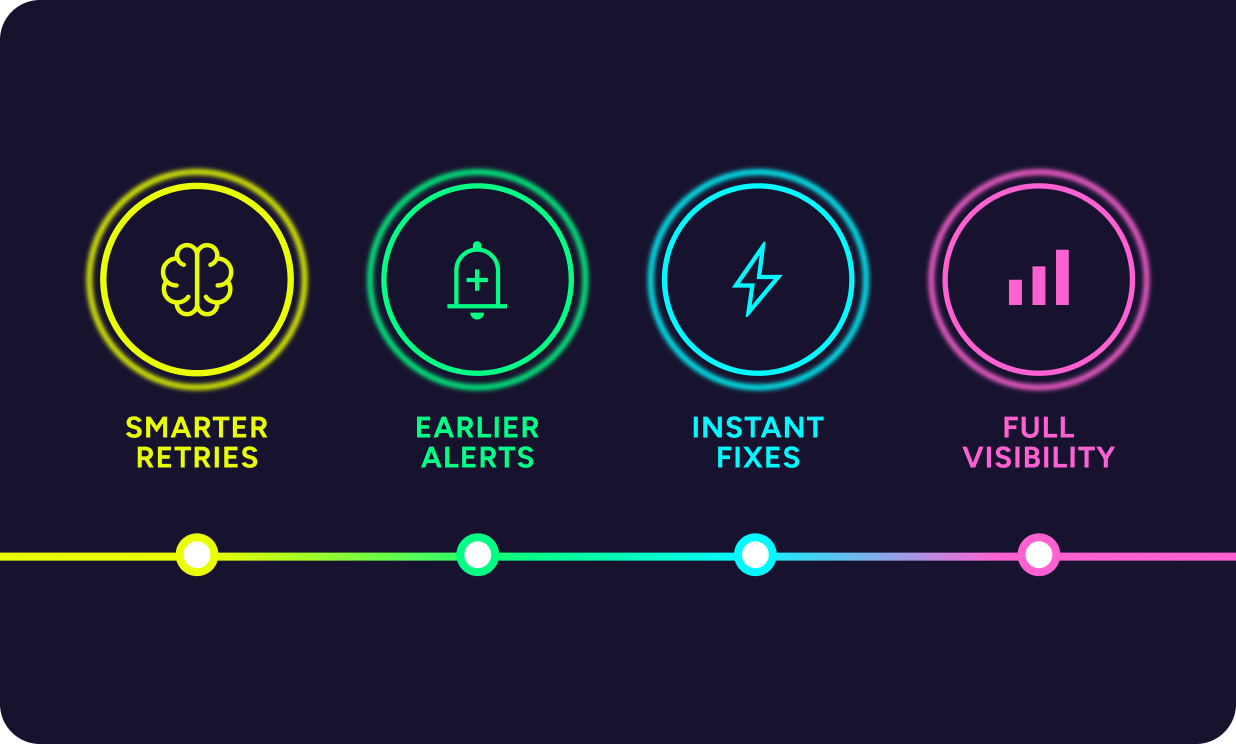
In our push toward Autonomous Subscriptions, these updates bring enterprise-scale payment recovery with agents that maximize successful payments, earlier failure alerts, frictionless card updates, and analytics that show exactly what's working.
Failed payments cost the average subscription business around 10% of ARR every year.
The cause isn’t customers choosing to cancel, it’s payment failures that end relationships they never intended to end.
And it’s easy to see where subscribers slip away: dunning emails go unread, the portal has one too many steps to update a card. What should have been years of loyalty gets cut short, and takes all the lifetime value with it.
Payments will fail. But every moment around that failure is yours to shape. Ordergroove turns those moments into recovered revenue. That’s Autonomous Subscriptions setting the enterprise standard for payment recovery.
1. Compound revenue recovery with autonomous retries
Most AI retry tools simply predict the optimal strategy from historical patterns. The question isn’t whether your retries should be smart. It’s whether the platform you use today has the testing velocity to keep making your retries smarter. Our Payment Agent, launched with Summer Groove, does exactly that.
Payment Agent
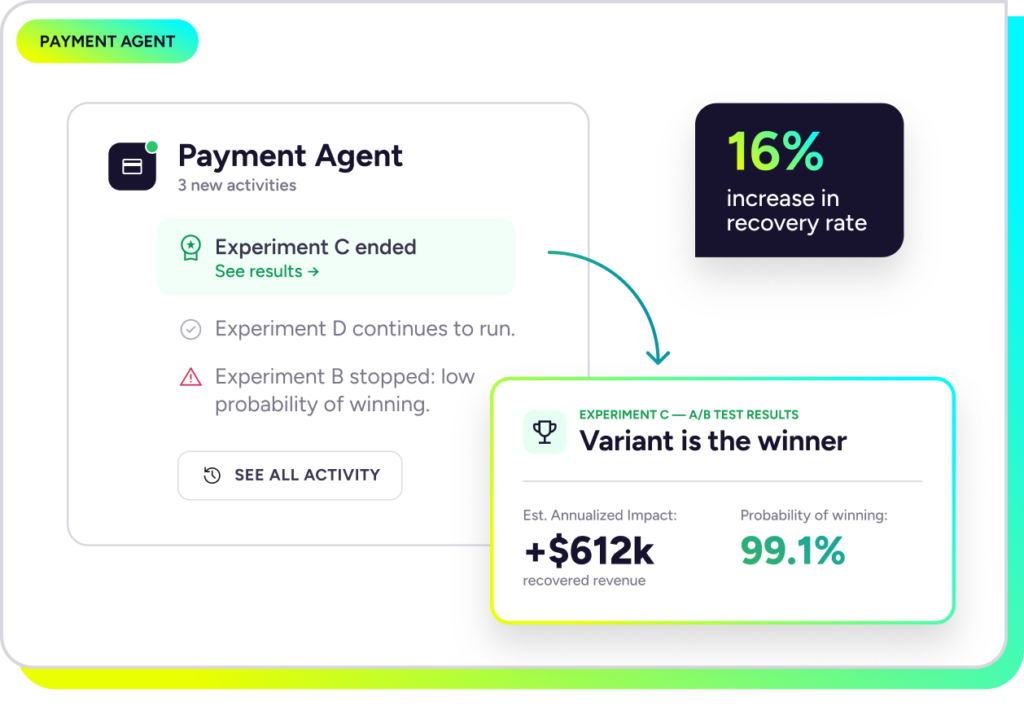
Payment Agent doesn’t just recover more revenue, it gets smarter at it every day, compounding your recurring revenue. It runs controlled A/B tests against your current retry strategies, automatically scaling the approaches that win, then starting the next test from that smarter place. Every strategy tested is informed by the Groove Network and what’s actually working at scale: behavioral signals and recovery patterns from 1,000+ enterprise merchants and $110B+ in transaction signals. Ordergroove merchants using the agent in early access are already seeing a 16%+ lift in recovery rates.
And unlike black-box AI tools that show only the lift, Payment Agent shows its work. Each strategy is tested against a control, results are measured, and improvements are implemented, so teams can see exactly why recovery rates are moving, not just that they are.
Join the early access waitlist here.
2. Reach subscribers before payments fail, with effortless updates
Even the best retry strategy still depends on the path a subscriber takes to actually fix a bad card. For most brands, that path has too many steps, too much friction, and too little reach.
These new tools help you reach subscribers with at-risk payments before they fail, and make payment updates as frictionless as possible at any moment in a subscriber’s journey.
At-Risk Payment Banner
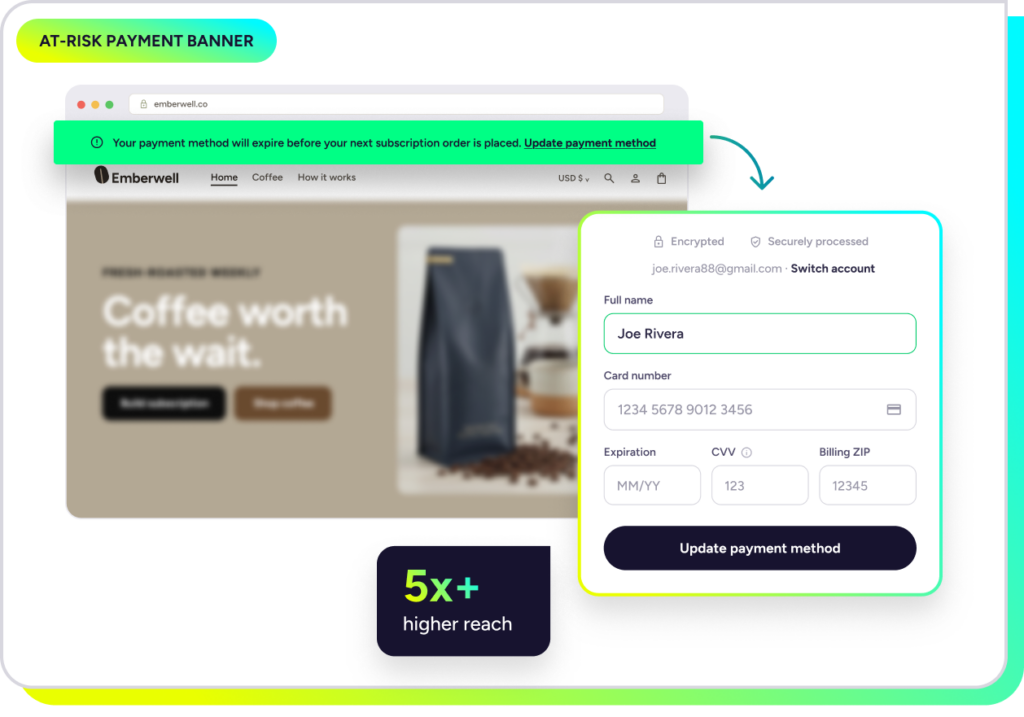
Before a payment even fails, if a subscriber with an at-risk payment method returns to a brand’s site, the At-Risk Payment Banner puts an alert front and center, with a clear, site-wide prompt to update their card, following them across every page they browse.
Early estimates show this banner expands the reach of a brand’s payment alerts by over 5x. It’s built to work anywhere: the subscription manager, your own custom headless experience, any eCommerce platform we support.
Subscribers-at-Risk API
For brands who want to use the same infrastructure and data behind the At-Risk Payment Banner to design their own experiences, the Subscribers-at-Risk API is a perfect fit.
By surfacing the subscribers with underlying payment-risk signals, brands can build their own at-risk banner, callout, inline alert, or whatever fits their storefront, and connect it to their recovery path, bringing the full payment-risk picture inside any surfaces they own.
Frictionless Card Updates
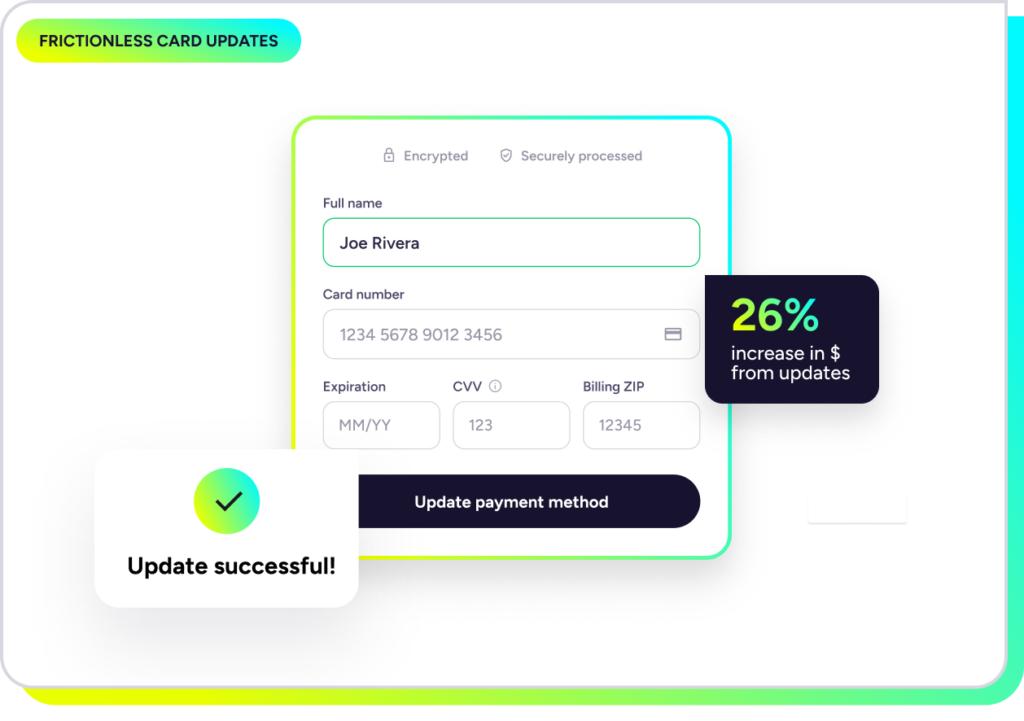
When a payment issue occurs, Frictionless Card Updates removes the need for a subscriber to log in, navigate the portal, and find the right card to update. Instead, merchants can offer a secure link across any channel that drops subscribers directly into a payment update form. One tap to open, then simply fill in card details and hit submit.
In early access, merchants are seeing up to a 26% increase in revenue from card updates. And the moment a card is updated through the flow, it triggers an immediate retry on any stuck orders, turning a card update into recovered revenue the same day.
3. Turn every card update into immediate revenue
After a subscriber has submitted their updated payment details, they expect the problem to be solved. But the stuck order is not always automatically retried, often waiting for the next scheduled sweep, which could be hours or days away, creating a gap between subscriber expectations and reality. Auto-Retry on Card Update closes that loop.
Auto-Retry on Card Update
The moment a subscriber updates their payment method, whether through the frictionless update flow, a Klaviyo email, the traditional subscription manager, or any other path, a real-time trigger fires and automatically retries any orders sitting in a failed state. No waiting, no manual intervention.
4. See exactly where payment health breaks down and close the loop
Recovery tools only go as far as the signal underneath them. And deciding where to focus, which payment recovery strategies are driving the biggest dollar impact, and where the biggest payment issues lie hasn’t always been easy.
Two new analytics views change that.
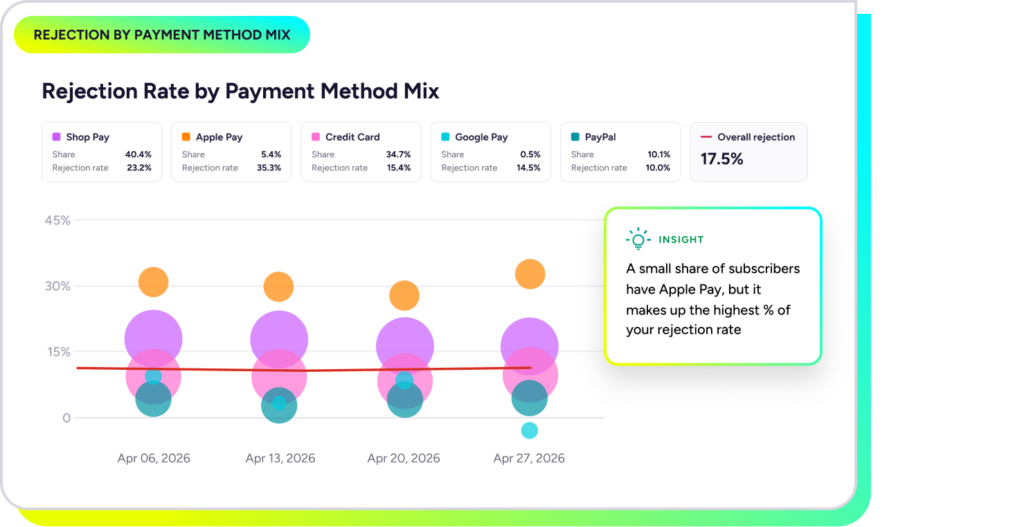
Rejection Rate by Payment Method Mix
Rejection Rate by Payment Method Mix is a bubble chart view that breaks down rejection rates by payment method, showing which methods (Shop Pay vs. Apple Pay, for instance) are driving disproportionate failure and what the dollar impact looks like. For merchants who have wondered whether a specific payment method is behind an outsized share of rejections, this is the clearest diagnostic view available.
Card Update Visibility
Most merchants can’t answer a basic question: what percentage of subscribers actually update their card after a decline? Without that number, there’s no way to know if your dunning improvements are working.
Card Update Visibility changes that. You start with a baseline: how many subscribers update their cards, how many of those updates recover rejected orders, and which decline reasons lead to successful updates. Then, as you make improvements, you watch the numbers move. For the first time, you can measure the impact of your recovery efforts instead of guessing.
Payments will fail. What happens before and after is yours to control.
Agent-driven retries that compound revenue with every cycle. Alerts that reach subscribers before a payment ever fails. Card updates that take seconds and become revenue the same day. Visibility that shows exactly where your strategy is working and where to push harder.
That is what Autonomous Subscriptions look like in practice for payment recovery: agents optimizing the approach, infrastructure removing the friction, and data closing the loop.
Schedule a demo to see our full payment recovery suite in action.