How Ordergroove Is Using GraphQL to Build AI-Ready Subscription Infrastructure
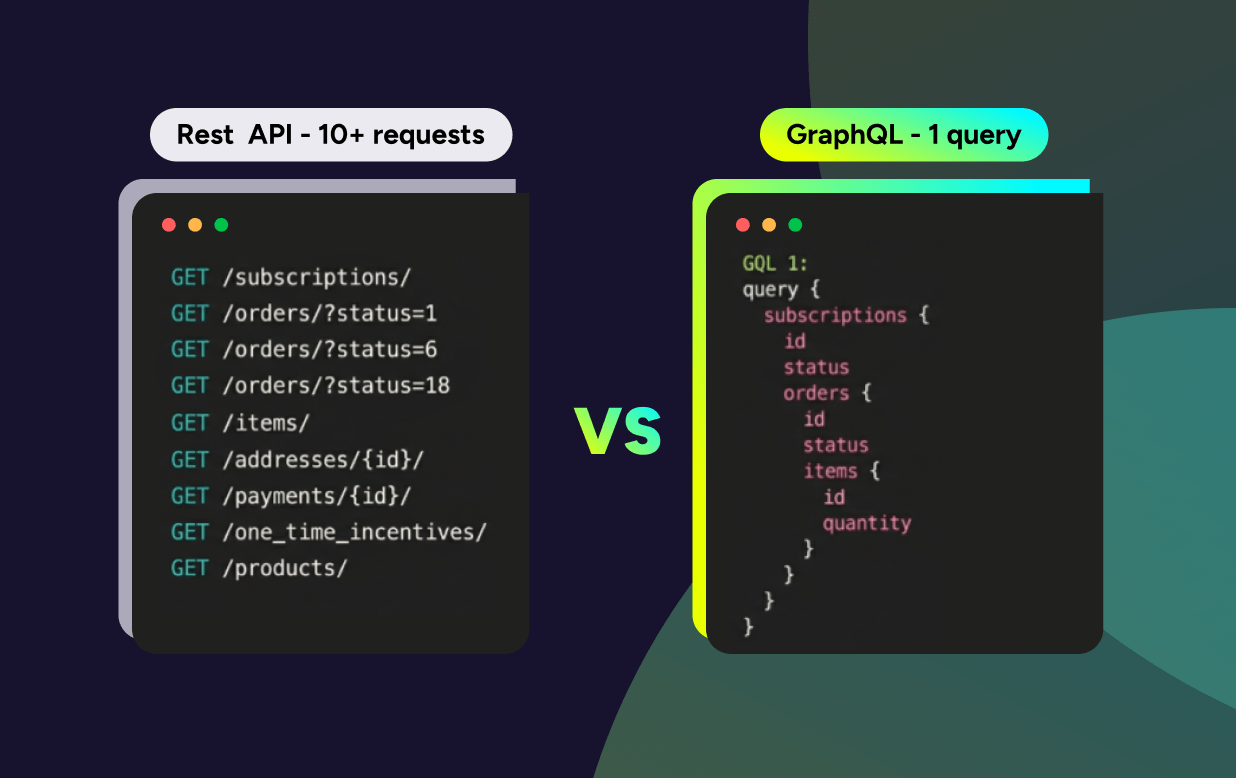
Your subscriber opens their management portal. They want to swap a product, check their next order date, and update a payment method.
For the subscriber, it should take seconds.
But behind the scenes, your platform is sprinting to keep up. It fetches the subscriber’s profile. Then their active subscriptions. Then their upcoming orders. Then product details. Then their discount eligibility. Then payment status. Each piece of data has to wait for the one before it, like a relay race where every handoff adds a delay.
By the time the page renders, your platform has made 10+ separate data requests. And your subscriber — your highest-LTV customer — is staring at a loading spinner.
The fix isn’t just making each request faster. It’s asking for everything at once in a single, precise call that returns exactly what the page needs and nothing more. One request. Exact data. No waiting in line. That’s GraphQL, and it’s live on Ordergroove today in early access.
But the real value of GraphQL goes beyond faster page loads. It opens the door to a more usable data layer for both developers and AI-driven systems.
Looking for the technical deep dive? Read the engineering deep dive on Ordergroove’s GraphQL architecture.
The REST Ceiling in Subscription Commerce
REST APIs are designed around individual resources. But subscription experiences operate across relationships.
As a result, rendering a complete subscriber view often requires chaining multiple requests together, one call per object, one dependency at a time.
But a subscriber experience isn’t one thing. It’s a web of connected data, including their profile, orders, products, discounts, and payment details. When that data has to be assembled one resource at a time, the experience becomes slower to render, harder to maintain, and more fragile to scale.
Even when each individual data call was fast on its own, assembling a complete view of a subscriber still meant stitching everything together on the merchant’s side. That added time, complexity, and more points of failure.
For brands building custom or headless storefronts, that burden was even heavier: they either had to pull far more data than they needed and slow the experience down, or build custom logic to manage the sequencing themselves.
Shopify ran into the same challenge at scale. Their shift to GraphQL reflected a broader reality: commerce data is deeply connected, and serving it one resource at a time makes complex experiences harder to support.
We arrived at the same conclusion for subscriptions.
Why GraphQL Matters for AI-Ready Subscription Infrastructure
Here’s the thing about AI agents: they’re harder to deploy reliably when data has to be stitched across disconnected endpoints.
With REST, an agent has to know what data exists, where to find it, and how to sequence multiple requests to assemble a complete view. That knowledge either has to be manually programmed in advance or guessed, and guessing introduces errors. Every extra step is another chance for the agent to get it wrong.
GraphQL simplifies that process. Instead of needing to be told exactly where to look, an AI agent can explore the full structure of Ordergroove’s data on its own, understanding what’s available, what connects to what, and how to ask for exactly what it needs.
That makes it easier to retrieve exactly what the experience needs, which is critical for making AI-driven experiences more reliable, scalable, and production-ready.
Merchant’s Early Results After Switching Subscription Manager to GraphQL
The payoff is already showing up where subscribers feel it most: speed. Merchants in Early Access are seeing subscriber-facing page load times up to 55% faster after moving Subscription Manager to GraphQL.
Instead of waiting on a long chain of dependent requests, Subscription Manager can now load the view through a single query shaped to the experience.
Right now, GraphQL powers the display lever: loading and rendering the Subscription Manager. Updates like product swaps and payment changes still run through our existing infrastructure, giving merchants immediate performance gains without requiring a full rebuild.
What’s Next
Now: GraphQL is live in Early Access, and merchants are already seeing up to 55% faster load times. Early Access partners are helping shape what comes next.
Soon: We’re rebuilding Ordergroove’s standard Subscription Manager on GraphQL, bringing those performance gains to every merchant without requiring a custom build.
Next: A more agent-ready foundation for subscription experiences. Consistent, navigable data structure. Pre-built views for the queries AI agents will need most. Looking ahead, that foundation lets agents handle order changes, retention offers, and payment updates reliably at scale.
The brands that lead in subscriptions will not win on features alone. They will win on the infrastructure behind faster, more connected, and more scalable subscriber experiences. GraphQL is a foundational part of how Ordergroove is building for what comes next.
Want Early Access to our GraphQL layer? Talk to your CSM or schedule a demo to learn more.
Want to build this kind of infrastructure? We’re hiring.